Jagmeet Singh is the most popular leader at the federal level. Many polls have shown this. His party, the NDP, is also up a good 3-4 points compared to the 2019 results and seems to have some momentum. Quite a contrast with the beginning of the last federal election when the NDP was fighting the Green around 10-12%.


It is therefore far from impossible to observe a mini orange wave. I say mini because this post isn't going to look at scenarios where the New Democrats were to increase as much as they did in 2011. I just want to see what happens if the NDP reaches 22, 24 or 26%. Would it affect the Conservatives or the Liberals more? All the graphs should be interpret in context of the current projections of this site.


First thing first, let's see if the NDP is becoming better at turning votes into seats.


At 19%, the NDP is projected to win around 30 seats. As you can see with the vertical points at 19 however, the NDP could win over 40 seats if efficient (lucky?) or as few as 20. It obviously depends on many things including where the NDP support is. But over 5,000 simulations, things even out. remember however that reality only happens once.

We can see that the average is picking up at around 22-24%. So the NDP is currently just below what we call 'la zone payante' in French. I guess we could say the 'touchdown zone' in English? Our electoral system usually creates such a zone at around 25% where parties start actually winning seats. The relationship is clearly not linear.


Who loses when the NDP increases? Well both but the Liberals are more affected.


It might be super obvious but the line is definitely steeper for the Liberals than for the Tories. The latter are losing 0.9 seats for every 1 percentage point increase of the NDP while the former are losing 1.9 seats (if I approximate with a linear effect).


Maybe a better visualization is to see what happens to the CPC and LPC seats when their leads (in percentages) over the NDP shrink. It's a more direct approach (in the graph above, it was possible for the NDP to be up by 1% but for the Liberals to also be up compared to 2019 for instance, thus mitigating the impact of the NDP's rise).


The Liberals are currently polling at 35% while the NDP is at 19%, so a lead of 16 points. For every point decrease in this gap, the Liberals are losing 3.7 seats. The Tories are only losing 2.7 seats whenever the gap shrinks. Again, I understand some of you will argue using the national numbers is meaningless and I should focus on the leads in Ontario and BC. That is fair but the simulations have correlations across provinces. So if the Liberals are dropping and the NDP gaining nationwide, it'll be the case in Ontario and BC as well.


And now maybe the weirdest graph: the number of seats for the CPC and LPC as a function of the number of seats for the NDP:


It is weird because the Conservatives have a very slightly positive relationship! That's right, the more seats the NDP wins in my simulations, the more seats the CPC wins as well. It took me a while to look deeper and understand what was happening.


The first part of the answer is what we have seen so far: the NDP has more races with the Liberals than the Tories. The second part is there are some seats that the Conservatives start winning when the NDP rises and the LPC is down. But there aren't as many seats the Liberals win if the NDP is taking votes from the Conservatives. So yes, vote splitting.


It's also a question of looking at correlations between only two variables when it's really a multivariate relationship. If you instead do a regression of the number of seats for the Conservatives over the number of seats for the NDP and Liberals, you get a negative relationship with both of these variables. So don't start thinking that the Tories necessarily love it when the NDP is gaining seats and rising in the polls. They like it to some extent if it means the NDP winning seats in Toronto, but they are a lot less happy when the NDP starts taking seats from the Tories in the West, including in BC.


So, overall, what have we learned? First of all, the NDP needs to likely be around 22% nationally in order to win 40 seats, one of their objectives. They can do it with a lower percentage of votes but higher efficiency of course. Second of all, a mini orange wave would likely hurt the Liberals significantly more than the Tories. It obviously depends where the NDP is rising (is it DT Toronto or BC) but, in average, it is pretty clear the NDP can hurt the Liberals more.

The first few polls of this campaign have been less positive for the Liberals than the ones in recent weeks. Trudeau is still hugely favorite to win the most seats but a majority is now less certain. At 59%, the odds are still in Trudeau's favour but it's significantly less than the 75+ we had just before the start of this campaign.


The Conservatives are doing much better in BC but are still trailing in Ontario. They are back above 100 seats but their chances of even a simple plurality are low (although increasing).


The two good news for the Liberals are Quebec where most polls still give them a big lead over the Bloc (note: except Leger) and what appears to be substantial gains among the 55+, a demographic that votes more than others.


Anyway, here are the latest projections:

Below the seat projections are the 95% confidence intervals


Detailed projections

Proj Canada 17 August 2021 by bryanbreguet on Scribd


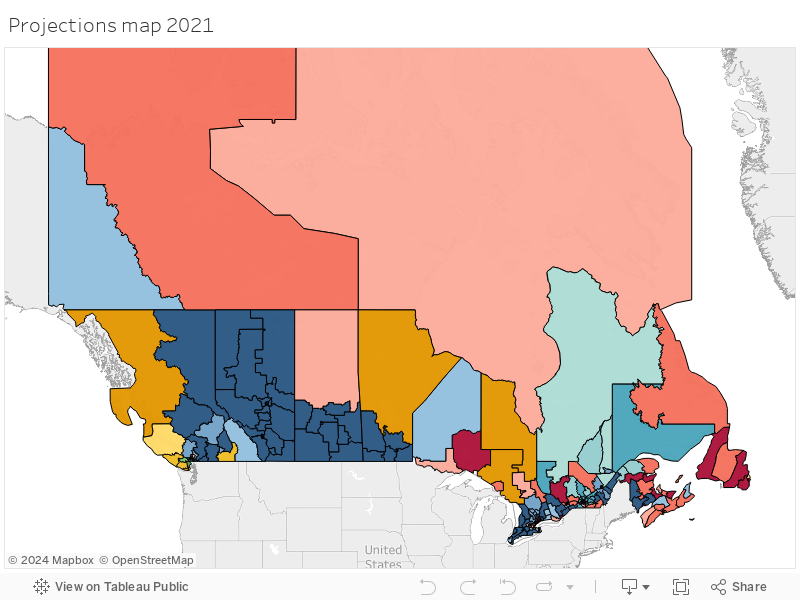
Map


Full page interactive version. Hold 'shift' to move the map around with your mouse cursor.


Alright, it's finally officially on. Early federal election starting today with e-day on September 20th.
Let's take a look at where we stand right now. If you want quicker updates, follow me on Twitter.

Projections

Voting intentions, seat projections with 95% confidence intervals, probabilities


Map


Full screen interactive version. Performance isn't the best (it depends), so give the map 1-2 seconds if you zoom in or out.

Short analysis

Trudeau has enjoyed a polling bump ever since Covid started, even though the gap has now been cut in half compared to what it was in April 2020. Still, given that the Liberals weren't that far from a majority in 2019 (with 33% of the vote, thanks FPTP!), it is natural that any bump would bring them closer or above the 169 seats threshold.


One caveat is that the Liberals won 157 seats in 2019 thanks, partially, to an incredible vote efficiency (i.e: winning close races; concentrating their support in the ridings they can win). That creates a somewhat weird situation where the Liberals could be up by a few percentage points and that wouldn't necessary translate into many additional seats. This is why the Liberals really need big leads over the Bloc (in Quebec) and the CPC (in Ontario) if they want a majority. As I showed a few days ago, the Liberals are comfortably in majority territory as long as they keep both leads to 10 points. But should one lead shrinks to 'only' 5 points and the odds of a majority are at 50-50 at best.

This is why I currently have the chances of a majority at 70%. It is there, no doubt about it, but the gamble that Trudeau took this morning might be more risky than it appears. The lead over the Bloc, in particular, doesn't feel as solid as the lead over the CPC in Ontario. I personally would expect Yves-François Blanchet to run another great campaign and bring his party to at least 30%. The most recent Leger poll showed that while people (including Québécois) are usually okay with Trudeau and his government, few would want a majority. This is something the Bloc can easily use to its advantage.

While Ontario is usually the center of attention for any federal election, it might be different this time around. This seems to be the most stable province compared to 2019 and Trudeau is polling actually lower than two years ago. It might be because the 'Ford effect' is now mostly gone, thus compensating the Covid bump? Don't get me wrong, the Tories are not doing better there, it's just that the gap with the Liberals is essentially the same.

Speaking of which, the Conservatives start this election with almost no chances of finishing first (not even a plurality). The party is bleeding on its right (many polls have shown that the CPC has lost more voters to the PPC/Maverick than to the Liberals) all while not making any gains in the center. O'Toole has clearly tried to re-center his party and enlarge his coalition, but it hasn't worked yet. So the CPC has this worst case scenario where the base is unhappy and the moderates aren't joining. The bleeding on the right might end up not costing too many seats (the CPC will just win the rural ridings in Saskatchewan and Alberta with smaller majorities) but it creates a situation where O'Toole has to fight on both fronts. Given the polling numbers, I wouldn't be surprised if the Tories decide to run a boring, catered-for-the-base campaign with the aim of saving the furniture (i.e: winning 100 seats) all while hoping the NDP and Bloc are preventing a majority. This plan might work as long as they don't drop too much in the West, in particular in BC where some polls are straight up disastrous for the CPC.

The NDP is the other party starting this election in good shape. Very different compared to the  beginning of the 2019 campaign where the NDP was polling at the same level as the Green party, around 10-12%. Singh ultimately won that battle (partially by winning the English debate) and enjoyed good momentum at the end of the campaign. It didn't translate into as many seats as they had hope but it created a strong foundation to built onto. Singh also benefits from being, by far, the most liked leader federally. If he plays his cards well, we could see a mini orange wave with the NDP gaining many seats in Ontario and BC. This could be helped by the fact the CPC isn't a 'threat' as far as forming the government is concerned, thus negating any call for 'strategic voting' the Liberals will throw around.

The Green party is collapsing in front of our eyes with a party actively sabotaging the efforts of its new elected leader. This is spectacular to witness but sad democratically. They already lost one MP (Fredericton) who decided she wanted to keep her seat and run for the Liberals (shameful but whatever) and they could well end up with only one elected MP, Elizabeth May, the former leader. I can't see this party getting its shit together during the next 4 weeks and I think the only real question is who benefits from the collapse, the Liberals or the NDP? Polls don't necessarily agree on that front.

Finally, the Bloc is polling significantly lower than in 2019 but things could change quickly. Blanchet is still liked and the Bloc as well. If the election becomes a question about giving Trudeau a majority, the Bloc would be ideally positioned. Blanchet also has the benefit of being able to campaign in Quebec every day while Trudeau will need to spend a lot of time elsewhere. My guess is the Bloc has the objective to regain some or the urban ridings it should have won in 2019 (Hochelaga, ridings on the south shore of Montreal). The Bloc could be under threat of the Conservatives if they were to increase in Quebec (both parties do share part of the electorate) but O'Toole's French is too weak in my opinion for him to make major inroads in La Belle Province. Also, as mentioned previously, the CPC will likely play defense for most of the election. That means spending more time in Ontario and BC than in Quebec.

Alright, that's all for now. Happy election!


Detailed projections

Proj Canada 15 August 2021 by bryanbreguet on Scribd

I have included the polls from Angus-Reid, Abacus and Innovative.


The Liberals are clearly in majority territory and there is almost zero uncertainty regarding who would finish 1st and second. Find the detailed projections below the map.

Map:


If you want an interactive version.


Projections:

Proj Canada 13 August 2021 by bryanbreguet on Scribd


Possible outcomes:


Qui dit élections fédérales, dit rôle important pour le Québec. Non seulement la province a un nombre important de sièges (78 sur 38), mais son électorat a prouvé qu'il était volatile. Le Québec est d'autant plus important cette année car il se pourrait fort bien qu'une majorité pour Trudeau passe impérativement par le Québec.


Partons des plus récentes projections ci-dessous:


Et la grande région de Montréal en particulier:


Si vous voulez les projections détaillées:

Projections Canada 2021 10-08-2021 by bryanbreguet on Scribd


Il y a aussi la carte intéractive ici.


Les Libéraux de Trudeau sont actuellement projetés en terrain majoritaire. Les chances que le PLC remportent au moins 170 sièges sont de 70%. Cela semble assez comfortable, non? Pas vraiment. Tel que je l'ai démontré il y a quelques jours, le PLC se doit de conserver deux avances: son avance sur le Bloc au Québec (environ 10 points actuellement) et son avance sur le PCC en Ontario (là aussi environ 10 points). Si le PCC devait grimper en Ontario ou le Bloc au Québec, atteindre le chiffre magique de 170 deviendrait bien plus compliqué.


Le Bloc est en baisse dans les sondages par rapport à son résultat en 2019. Pas de beaucoup (environ 4-5 points) mais, couplé à la progression des Libéraux (en hausse justement de 4-5 points), cela génère des gains importants pour le PLC. Des comtés comme Abitibi--Baie-Jaimes, Rivière-des-Milles-Îles, Thérèse-de-Blainville ou encore Montarville. Le PLC se retrouve à 44 sièges (progression de 9) et le Bloc à 22 (perte de 10). Petite remarque, le modèle part du principe que Ruth Ellen Brosseau se représentera dans Berthier-Maskinongé pour le NPD. Mais cela semble peu probable et je devrai ajuster ce comté manuellement. Ce siège devrait ainsi revenir au Bloc.


Les sondages ne semblent pas s'entendre sur le score du Bloc. Alors que Nanos a toujours ce parti très bas (25% et moins), d'autres l'ont bien au-dessus des 30%. Aussi, il semble assez probable que le Bloc et Blanchet ne puissent pas rivaliser avec la couverture médiatique que reçoit Trudeau hors campagne électorale (merci Covid!). Mais cela devrait changer une fois en élection. Donc partons du principe que les intentions de vote pourraient rapidement se retrouver proches des résultats de 2019. Si l'on regarde ces derniers, on remarque que bien que le Bloc ait connu une bonne élection, reprenant beaucoup de sièges du NPD, il s'est buté sur un PLC efficace sur l'île (Hochelaga) et sur la Rive-Sud (Chateauguay par exemple). Le Bloc a perdu plusieurs luttes serrées, probablement car le PLC avait une meilleure organisation.


De manière plus générale, le Bloc est un peu un parti de gauche (son programme, ses députés) mais avec un électorat de droite (plus masculin, plus agé et avec moins de diplômés universitaires). Sur bien des enjeux, on voit que les électorats Bloc et PCC se rejoignent (ne pas aimer Trudeau par exemple ou si l'on regarde les 2e choix). Je ne dis pas que les électeurs Bloquistes sont tous de droite, je dis juste que ce parti a un électorat qui est plus à droite (et davantage susceptible de voter PCC) que les électorats du PLC ou NPD. Le seul point où les électeurs du Bloc semblent en désaccord complet concerne les changements climatiques. On n'a plus un Bloc qui dominait tout l'est de l'île et qui gagnait même dans Ahuntsic. Non, le Québec a vécu plusieurs ajustements entre 2008 et maintenant et le Bloc actuel n'est pas le Bloc de Duceppes en 2008.


Le défi principal de Blanchet lors de la prochaine élection sera d'essayer de regagner ces électeurs plus à gauche dans les centres urbains et en banlieues. Sur l'île de Montréal, le Bloc devra aussi compter sur un NPD qui ressemble de plus en plus à un Québec Solidaire fédéral. Des comtés comme Hochelaga ou Sherbrooke pourraient bien se retrouver sour le NPD. Mais les comtés en banlieues devraient rester une lutte Bloc vs PLC. Le Bloc devra aussi se méfier d'une possible poussée des Conservateurs avec leur nouveau chef, mais il est trop tôt pour parler des chances que cela arrive. Cela étant dit, une montée du PCC se ferait probablement au détriment du Bloc en régions et pourrait causer des courses à 3 qui favoriseraient le PLC.


Au final, si Blanchet pouvait conserver ses 32 sièges, cela mettrait le PLC aux environs des 170 sièges au total, soit juste au-dessus d'une majorité. Cette dernière reposerait ainsi sur des gains en Alberta (Calgary, Edmonton) et en CB. Une majorité resterait possible mais bien moins probable. De plus, si le Bloc devait réussir à regagner les comtés sur la Rive-Sud (en partie grâce à une meilleure organisation qu'en 2019), alors le Bloc pourrait bien faire des gains et ruiner les chances d'une majorité pour Trudeau.

My latest projections (done before the latest Abacus and Angus-Reid polls but adding them doesn't change much) showed Trudeau and the Liberals in majority territory, I also mentioned that this majority was far from guaranteed. Many things would need to go right (or stay right) for the LPC to get over 169 seats. The chances were about 66%, not bad but an early summer eleciton 9during a potential 4th wave) does have some risks for Trudeau.


I then wondered which variable was the most important. Is it the lead the Liberals have over the Bloc in Quebec? Or maybe it's the lead they have over the CPC in Ontario. Or maybe the key is actually in Alberta and BC. The beauty of running simulations is that I can then use the data to answer such questions. So I used the results of the simulations (specifically the number of seats won by the Liberals) and looked at the correlations with multiple variables. I used a Logit regression to do so. Here below is the result.


If you don't know what a regression is (even less a logit regression), just know that it measures correlations while holding the other variables constant. So we get marginal effects. A logit is just a specific form of regression used when the dependent variable (the one we are trying to explain) is binary (1 for a majority, 0 otherwise). Using the results, we can estimate marginal probabilities (what happens to the chances of a majority if the Bloc gains 2 points over the Liberals in Quebec?) as well as doing some nice little graphs.


For the logit regression, I included the following variables: the gap (in voting intentions in %) between the LPC and Bloc in Quebec, the gaps between the LPC and CPC (as well as LPC and NDP) in Ontario, Alberta and BC. I didn't include the country-wide numbers as they were irrelevant (I tried at first), which makes sense.


So, what is the single most important factor? In magnitude, it's the LPC-CPC gap in Ontario, followed closely by the lead of the Liberals over the Bloc. The two are very similar and the LPC-Bloc gap is actually more significantly statistically. I'm not saying that the lead of the Liberals over the NDP in BC isn't important, just not as much.


It makes sense really and you can simply use the model to run some simple simulations (you can try with the simulator yourself although the current numbers in it aren't the most up to date, but you can change them). Using my model with the most updated numbers, I get that a swing of 10 points (-5 and +5) from the LPC to the Bloc would cause the Liberals to lose 11 seats. A same swing between Liberals and Conservatives in Ontario would cost Trudeau 17 seats.


Both simulations show that the Liberals need to keep those two leads if they want to win a majority. If they were to lose either of them (note: at this point, their lead in Ontario is a lot more solid than their lead over the Bloc as Quebec is always unpredictable), their chances of a majority would essentially become 50-50 at best.


Graphically, let's represent the probabilities of a Liberal majority as a function of the lead of the Liberals over the Bloc in Quebec and over the CPC in Ontario:


The current leads are, respectively, about 10-11 points over the Bloc and about 9-10 points over the Tories in Ontario. Both would indicate about a 60-70% chances of a majority, which matches (obviously) my latest projections. But what this graph shows is that the chances are more sensitive to a drop of this lead in Ontario (steeper slope). All those seats in the 905 would come back into play if O'Toole could gain a little bit over the Liberals compared to 2019. Side note, but this is why I don't think the Tories really have no chance of winning a plurality or that they were soooo far from it in 2019. The fact is that you can easily have 10-20 seats flipping in Ontario and doing so would bring the Liberals not only below 170, but much closer to the Conservatives.

Alright, let's do this again. And by this, I mean making projections for a federal election. I haven't been particularly successful for federal elections (compared to provincial ones) but I decided I had time to cover the upcoming federal election. If you have any questions, just follow and ask me on Twitter.


My model in 2019 performed okay (making 38 mistakes using the actual percentages of votes from the election) but was underestimating the Liberals. This was mostly due to an incredible vote efficiency from the party of the Prime Minister. Not only did they win most of the close races they were involved in (something like 15 out of 20 but don't quote me on this), they also reinforced their urban vote, which allowed them to continue winning not only the entire city of Toronto, but seats like Halifax or many in urban centers in the West.


Since then, I have updated the model with demographics (age, gender, income and education) in the hope of capturing any shift of the electorate (beyond the top race numbers).


Anyway, here are the first projections of this (currently non-official) 2021 election.

LPC: 181 seats

CPC: 103

NDP: 30

Bloc: 22

Green: 2


You can see an interactive version of the map here. Performance is okay (and it varies with your computer and internet connection) but isn't the best, so allow 1-2 seconds after zooming in or out. Sorry but this is the best mapping software I found and that I can use easily.


The Liberals have been polling well over the last year, fully benefitting from a Covid bump like many other incumbents. However, the current lead is significantly less than it was in spring of 2020. It's still enough to currently be projected with a majority but the number of seats (181) might be giving a false sense of how safe this majority is. The seat total for the LPC is only that high because the Bloc is polling, in average, at only 28%. But this party has been polling all over the map, from being as low as 22% to as high as 37%. The Bloc is also a party that would likely benefit from a campaign (more exposure). I'm not saying the polls are wrong, I'm saying Quebec is unpredictable and I'm not sure the Liberals are really ahead there by over 10 points.


This is important because if that's not the case, then the Liberals are barely above the 169 needed for a majority. Yes they'd make gains in Atlantic, the Prairies and especially BC (really good polling numbers!), but they'd also also lose some urban seats to the rising NDP (Davenport in Toronrot, etc). Without Quebec, the Liberals are right on the edge of a majority.


Maybe the most important element is that the Conservatives don't really have a shot at forming the next government, at least not right now. I have their chances at 2% of winning a plurality (which might not be good enough for Erin O'Toole to become PM) and their chances of a majority at a solid 0%. Campaigns matter but right now, even with a massive polling error, there is no path to 170 for the Tories. This is incredibly important as it creates a completely different dynamic from 2015 or 2019. Trudeau cannot, in particular, scare progressive voters into switching from the Green or NDP to the Liberals to prevent a CPC government. Coupled with the popularity of Singh (by far the most liked leader in the country) and the rising NDP numbers and we might have all the ingredients for a mini orange wave. I'm not talking of the NDP reaching 35% and forming the government (not yet?) but the NDP having the clear momentum for the first half of the campaign and eating both the Liberals (in Ontario) and the Tories (BC).


Anyway, I don't intent on doing an overly long analysis right now. So please find the detailed projections here and see you next time.


Projections Canada 2021 5-08-2021 by bryanbreguet on Scribd