Alright, it's already time for a new CPC leadership race! I had a lot of fun covering the 2017 and 2020 ones so I'm pretty excited. Especially because this one looks to attract more high profile candidates -- more likely because everybody in 2017 thought (wrongly) that Trudeau was unbeatable in 2019. As for 2020, MacKay had such a large initial lead that many got scared (wrongly again).

So let's look at who's running and where the race likely stands right. Fair warning, the latter part is heavily speculative at this point since we have very little data at this point. If you already know the candidates, skip to section 2.


1. The candidates


1) Pierre Poilievre.

He was first to announce, very early on. He actually said he was running for Prime Minister, not for CPC leader! The pedantic crowd (the same people who insist on calling a minority a hung Parliament) was quick to point out that in our system, nobody runs for PM (wow wow wow, if this PoliSci degree isn't proving useful!). Personally, I thought it was a fairly smart move as he's making clear that he'll use the same message during the leadership and during the general election (hopefully at least), unlike some former CPC leader...

Poilievre is known as the 'attack dog' of the CPC. He can attack Trudeau non-stop, so the base obviously loves him. His attacks sometimes land effectively but can also just make him look really partisan at times. Many will say he's like Trump but that's wrong. Stop thinking everybody on your right is 'like Trump'. Poilievre is more like Ted Cruz, hyper partisan. If you are terminally online, you either love him or hate him -- not unlike some Liberal leader currently PM!

His critics will argue that he's too caustic and would push away moderate voters, especially women. His partisans will say that the CPC tried the moderate route with O'Toole and literally lost seats in the GTA and GVA. Who is right? My personal opinion is that terminally online people need to stop assuming that everybody is like them and hasn't touched grass in a long time (if you don't get the reference, congrats, it means you are a normie). The polling numbers we got so far (see further below) have not indicated that Poilievre is 'unelectable'. And I maintain that his campaign so far (mostly composed of really polish videos) has been quite good with a positive messages aimed not only at the base (much Freedom! and F*ck Trudeau!) but also at immigrants and First Nations. I might be wrong here but I have so far seen someone with a wide range (something O'Toole definitely didn't have) and who knows what message he wants to sell. His main challenge is that he does appear off putting to many moderates, at least among the online crowd. It's not so much his policies (he isn't a SoCons for instance) but his style.

He is, without a doubt, the favorite at this point. He is also bilingual (not perfect but very good), a welcome change from Scheer and O'Toole.


2) Jean Charest

Wow, I didn't think I'd one day have to make projections again for that guy! Can't believe he's back. His name was thrown around in 2020 already but he opted to stay out. What changed his mind this time around? Maybe the fact that 2024 looks a lot more winnable for the CPC with the Trudeau fatigue? Maybe it's the fact many Tory MPs from Quebec went to beg him to run (I get the feeling many in the Quebec caucus don't like Poilievre).

Charest is a formidable politicians who has a history of successes. With that said, his tenure as Quebec Premier ended quite badly and many in the province still hate him. People also seem to have forgotten that while he won in 2003 and 2008, he suffered pretty bad losses or quasi losses in 2007 and 2012. So his record is far from perfect.

Charest, who is announcing his candidacy today in Calgary (hey, he ahs to convince the base he's not a Liberal!), will base his entire campaign on his winning record. He will need to convince the CPC membership (who is significantly more right wing than the country or even the CPC voters) that they need a moderate/centrist candidate to win those centrist voters. He's the favorite of many so-called Red Tories on Twitter. On paper he makes a lot of sense. He is indeed moderate (although he is definitely a conservative. Don't be an idiot thinking he's a Liberal because he was the leader of the Quebec Liberals. That party was quite right wing under his leadership, similarly to the BC Liberals) and he's from Quebec, so he could finally allow this party to get more than 10 seats potentially.

I think the reality might be less rosy. First of all, I have been on record arguing that the obsession with the 'moderate voters' was unhealthy. I'm not convinced there are millions of 'Blue Liberals' voters who are waiting for a moderate CP leader to jump ship. I think 2021 showed that the suburban so-called moderates are quite satisfied with Trudeau. It is of course possible that O'Toole's strategy was well intentioned but badly executed (like having a ridiculous 'carbon rewards' that satisfied neither the pro carbon tax liberal swing voters or the anti tax conservatives) and the environment (Covid) was hostile. So a better leader with a better campaign could maybe pull it off and finally turn a lot of the GTA blue. I'm doubtful because the only time the GTA really went CPC was in 2011 under extraordinary circumstances that aren't likely to repeat any time soon. I also believe that the CPC has other paths to power, including winning more rural ridings in Atlantic Canada, Quebec, Northern Ontario and Northern BC. Still, 2024 could be perfect for a moderate CPC leader to offer an option to dissatisfied Liberal voters. I'm not convinced Charest is the best for that role though. He has a lot of baggage (he literally worked for Huawei recently!) and is straight up hated by many in the CPC (including Stephen Harper who hasn't forgotten how antagonistic Charest was to him while he was Premier and blocked his candidacy in 2020). If you ask me, a Charest wins would lead to multiple MPs leaving the CPC. To be fair, a Poilievre wins would likely mean a few Quebec MPs would leave as well.

I'll, however, give Charest credit for his decisions so far. He has explicitly been friendly to the SoCons (Social Conservatives), a smart move compared to MacKay who went straight up against them in 2020 and paid the price (he got almost no second ballot support). 


3) Leslyn Lewis

She came out of nowhere in 2020 and almost won. Yes she really did. She finished 3rd in points (the CPC leadership awards 100 points to each riding no matter how many members vote in it, unless it's fewer than 100 votes in which case the number of points is equal to the number of votes. So it's possible to get more votes but fewer points if your vote is inefficient) but 1st in votes after the 2nd round. She wasn't far from qualifying for the final round and my calculations show that she likely would have beaten MacKay (it's less clear if she'd have beaten O'Toole as the MacKay voters would likely have switched to O'Toole according to the data and my calculations).

She is a social conservative and not ashamed of it at all. She didn't speak a word of French in 2020 and that ultimately cost her the leadership (she finished 4th in Quebec with only 10%). I'm not sure how much she has improved since. She is now a MP (from Ontario) but I get the feeling her rising star has somewhat faded. It's not clear if she can replicate the 'lighting in a bottle' of her 2020 campaign.

If she can though, she has legitimate chances. She will likely be the only SoCons and that represents a good 20-30% of the membership. If the other factions (like Blue Tories/Harper Conservatives and the pragmatic/moderate conservatives) are divided enough and she manages to be ahead of Poilievre after the 2nd or 3rd round, I could totally see her winning the whole thing.

Would the CPC have any chances with her as leader? Many people will say no. I honestly don't know. She'd be a very unique leader and I'm not sure what would happen. I'm not saying she would likely win, I'm just saying I can't exclude some surprises. She could maybe attract more of the socially conservative immigrants in the suburbs. She is such a wild card that it's hard to predict what would happen.


4) Patrick Brown

He hasn't announced yet but is supposed to do this Sunday. He's the mayor of Brampton and was the former Ontario PC leader (and cruising towards victory) in 2018 when he got (wrongly, seemingly) accused of sexual misconduct. He had to resign and Ford won the leadership and became Premier (the 2018 Ontario election was such that I believe literally any PC leader would have won it, although I have to give Ford credit for his unique appeal to the GTA voters). He is known to be a terrific organizer and can sign a ton of people (he did when he became the surprise PC leader in 2015). He is clearly a moderate (his haters will straight up say he's not conservative). He has been quite good the last few months on Twitter and in the media. He is very opposed to Bill 21 in Quebec and, if he were to become leader, I'm not sure how the Quebec caucus could remain as Brown would publicly oppose and fight Bill 21.

I personally think he's the best option for the moderate/Red Tories members, much better than Charest. Rumors of a deal between them are already out there, although they both denied it. If the CPC is looking for a fresh start with a moderate, he is likely their best guy. As mentioned before, Charest has problems and MacKay doesn't look like he's running. Short of someone like Rona Ambrose running, I see Brown as the frontrunners among the moderates. I know the poll below doesn't show this but it's early.


5) Roman Baber

An Ontario MPP who was kicked out of the PC caucus for his objection to the lockdown measures. I honestly don't know much about him. He seems to be a wild card and will likely try to get the vote from the anti lockdown/muh Freedom crowd. I don't see a scenario where he wins right now but it'll be interesting to see whether he causes Poilievre some troubles by stealing some of his target audience.

Sorry, I wish I could say more but I don't know the guy well enough.


2. The state of the race


As mentioned before, it's very early. But here's the data we have.

First, we got a new poll from Leger this morning. Polls will obviously be imprecise as they usually can't sample from the membership directly. Still, past leadership races have shown that general polling (among CPC voters) was still indicative of the general trend. I'll use better data (such as fundraising) when comes down the time to make projections, a technique that has proven quite successful in the past). Here's the main graph from this poll:


It's not even close as Poilievre is clearly ahead. Not very surprising. His announcement video got over 2 millions views. His lead here is very significant. We don't have the full pdf at the time of writing this post. The article of the Journal mentions that Poilievre leads everywhere west of Quebec while Charest is ahead in the Atlantic and Quebec.

I'm a little bit surprised by the numbers for Lewis here. It might be because the sample is CPC voters, not members. Also, the MacKay votes should likely be added to Charest and Brown. Notice as well the high number of "I don't know". All in all, not the most precise measure.

The voting intentions (very hypothetical) also show that Charest wouldn't be the slam dunk many thought. At the same time, I think that we are living in such a set, polarized political world (half of the Liberals voters are TruAnon who will support Trudeau no matter what while half of the CPC members suffer from Trudeau's derangement syndrome) that we shouldn't expect massive swing just because of the new leader.

The CPC under Poilievre is at 30% and at 28% under Charest.

Abacus has shown that many don't actually know either of Poilievre or Charest (again, not everybody is terminally online).


So, as it stands, Poilievre is the clear favorite. He is liked (loved!) by the base and has many supports among the caucus (including the recent endorsement of Scheer which is significant). If the vote was tomorrow, I'm sure Poilievre would win easily.

Can someone beat him? After all, both the 2017 and 2020 races ended up with the early favorite losing.

Okay let's run some scenarios. The first way Poilievre could lose is if Lewis wins. As I said previously, she was actually quite close in 2020. SoCons representing 20-30% of the vote (own calculations but in line with a poll by Mainstreet in 2020 among the members), she is guarantee a good showing in the first round. If Charest and Brown can split enough of the pragmatic/moderate voters (Mainstreet had them at 45% in 2020, I would personally put that number around 30% currently) away from Poilievre (leaving him with the Blue Tories/Harper Conservatives only (about 30% of the members), we could have her ahead of Poilievre after 2-3 rounds. For this to happen however, one of Charest/Brown would likely need to drop or finish further down (and therefore be eliminated already). If you want numbers, here's a scenario

1st round:

Poilievre 30%

Lewis 25%

Brown 20%

Charest 15%

Others 10%


Others mostly go to Lewis, Charest is dropped and his voters mostly go to Brown. After the 3rd round, the situation is the following:


Brown 34%

Lewis 34%

Poilievre 32%


Then Poilievre is out, his voters likely elect Lewis as leader.


The other scenario is where the moderate/centrist candidates sign a lot of new members and expand the base. Some articles have mentioned how Charest (or Brown) likely need to 'replace' the current CPC members by signing up 200-300k new members. This would be like a hostile takeover of the CPC by the former PC wing. Is it realistic? Well, the CPC had 259k members in 2017 and 270k in 2020. So one or two candidates literally doubling this? I have my doubts but everybody is telling me to watch out for Brown. What I agree with, however, is that a Brown/Charest win will come with signing many new members. The 2020 membership base of the party would just guarantee a Poilievre win. Basically I think Poilievre would take the O'Toole votes (True, true blue baby!) while Charest would replace MacKay but do worse (less goodwill with the CPC membership).

Speaking of which, surely he should be able to sweep Quebec and this province is really rich in points (although less so than in 2020 but the impact is exaggerated by many online). Well look at the Quebec numbers from Abacus:


That doesn't look good for Charest. Let's also remember that simply being from Quebec doesn't guarantee much. Bernier actually lost Quebec to Scheer! The points system can create weird results but the fact remains that many Conservative members in Quebec are likely closer to Eric Duhaime (ex radio pundit and leader of the new Conservative party provincially, a party that has risen in the last few months thanks to its strong opposition to the Covid measures) and the American right than to Charest. So while Charest should have the edge, I'm not sure it'll be the case in reality. Charest has also said he was opposed to Bill 21 so that's already a serious handicap in winning over Quebec conservative voters! Evan Scrimshaw said Charest was like Canada's Jeb Bush and I think he might be right.

Don't get me wrong, there is a path for Charest but it's a narrow one.


3. Who can beat Trudeau?


Isn't this ultimately the real question the CPC members should ask themselves? Sure, but the base can be dogmatic at times and the O'Toole experiment with his centrist approach (and lack of results) has left many dissatisfied and they would rather elect a 'true conservative' (even though O'Toole did improve things, just not enough to win seats). As Andrew Coyne said, you can betray the principles/dogma and win or lose while respecting them. What you can't do however is betray the base and lose, which is what O'Toole did.

If you spend all your time reading the opinion of professional pundits, you likely read that the CPC needs a centrist like Charest/Brown in order to win the GTA voters. As I've said previously, I see the logic on paper and 2024 might indeed be the right election, but I also think this is a strategy that the CPC has tried multiple times and failed. For them to win the GTA, they need the Liberals to be incredibly unpopular and the NDP to split the vote. The party of Jagmeet Singh is pretty useless at this right now. It's a woke urban party that somehow wins zero seats in Toronto (for 3 elections in a row!) and actually win seats in rural regions like Northern Ontario and BC.

We have observed a re-alignment worldwide where urban and suburban voters have moved left while rural voters have moved right. The NDP is only winning Norther Ontario because the NDP used to be the working class party (unions, etc). It's less and less the case. Similarly to what we saw in the US where Trump lost support for the GOP among the affluent suburbs but made massive gains with the non-college educated, working class rural voters, I believe the path to power for the CPC is more through a sweep of rural riding than through an unlikely GTA breakthrough. And to achieve this, a more populist approach is necessary. That's definitely not Charest.

Let's be clear here, my opinion on this issue is a little bit controversial. But 2021 changed my mind as the Liberal vote in urban and suburban ridings is just too efficient. I'm not saying the centrist/moderate approach can't work, I'm just saying the CPC should maybe make sure not to lose more voters to the PPC. Below is the map of the seats the CPC lost by a margin inferior to the PPC's share of votes (Credit to @CaelemSG).


Yes I know that it's incorrect to assume that 100% of the PPC voters would have voted CPC (many PPC voters were actually former Green voters!) but there is a pattern here. The split with the PPC is costing the CPC seats exactly where it should make gains. The rust bell in Ontario, Northern Ontario and BC. The CPC should logically win those seats in the future thanks to the re-alignment. Add those 21 to the 119 and the CPC is at 140. Then add some gains in Atlantic and rural Quebec and that could be enough for a minority without massive gains in the GTA or GVA! For those two regions, having a leader that go and speak with visible minorities and immigrants (something O'Toole didn't really do) could go a long way.

The Leger poll of this morning showed one clear difference in the voting intentions between Poilievre and Charest: the PPC is much lower if Poilievre is the leader. If the CPC wants to go with a more populist, anti-elite, working class approach (which I believe is the key to success), Poilievre makes a lot more sense. If they want to go with a centrist approach and try to finally win through the GTA, then Brown is likely your guy. Charest, in my opinion, fits neither option very well.

For another take on this race (and the difficult path for Charest) and the path to power for a candidate like Poilievre, read this piece from John Ivison this morning.

Here we are after 36 days of an election in the middle of a pandemic. Canadians are getting used to those though. So here's the executive summary for you busy people. If you want more, read below.

You have the voting intentions based on the polling average, the seat projections with the 95% confidence intervals as well as the chances of winning the most seats.

The possible outcomes are:

LPC plurality: 60% chances of happening

LPC majority: 18% chances

CPC plurality: 21%

CPC majority: 1% (not impossible! Remember this if it happens lol)


If you want the riding by riding projections, scroll to the bottom of this blog post.


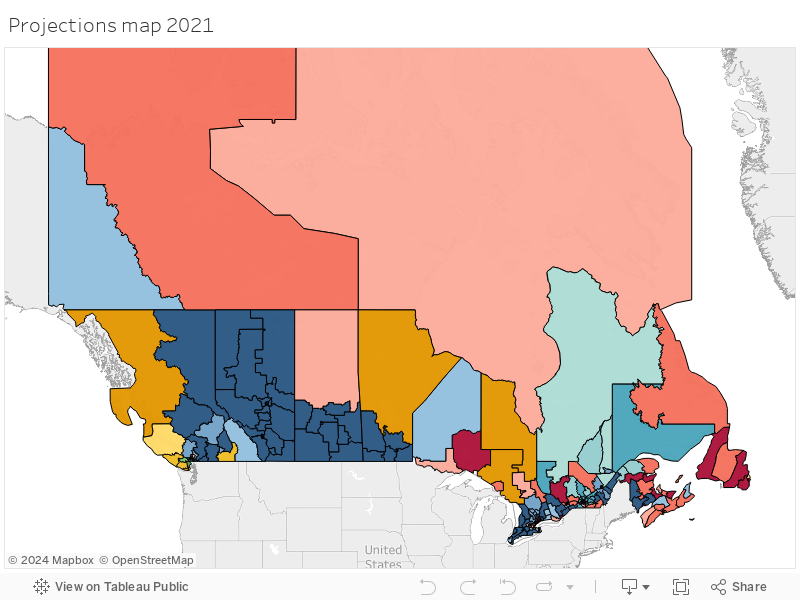
The map


Full version here.


Polls are far from perfect and there is always considerable uncertainty. My simulations use an actual margin of error of over 4%, in line with the effective margins estimated using past elections. Federal elections haven't had a huge polling mistake though, the failures were at the provincial levels. My probabilities have never failed at the riding level, meaning that every candidate projected with 100% have won and every one at 0% have lost. Hopefully the streak continues tomorrow night.


The most likely outcome is a Liberal minority. If polls were to be wrong, a CPC plurality is slightly more likely than a Liberal majority, but both outcomes wouldn't shock me tomorrow night.


1. The polls


This election was marked with a quick rise of the Conservatives. After about a year and a half of trailing the Liberals significantly (since covid-19 stared really), including during this summer, the Tories just caught back to the Liberals as soon as the campaign started. It looks like the unhappy Conservative voters (in Alberta for instance) just decided to rally behind O'Toole, at least for a while (before some decided to leave for the PPC).


We even saw the Conservatives take the lead at some point, although the average was heavily influenced by the very volatile IVR polls (some of which showed the CPC with a 8 points lead at some point, lol). Online polls (like Leger or Abacus) have been stable for weeks. IVR polls also disagree with online one for the age crosstabs. IVR polls have the Tories doing well among the 18-34 but trailing the Liberals in the 55+ while online polls have the Conservatives slightly ahead with this important demo (they vote more). The two effects cancel out for the overall numbers but it's still weird. Using the average, here are the voting intentions by age:


If the turnout is low tomorrow and skews heavily towards the 55+, it could explain some potential errors we'll observe. It should be noted, however, that the Liberals are making gains with the 55+ this election. They have a fairly different coalition of voters compared to 2015 when they dominated the 18-34. Speaking of demographics, the Liberals are also losing a little bit among the university educated (NDP gains) and among men (they gain among women which creates a really huge gender gap).

There is some momentum for the Liberals at the end although, there as well, it's mostly driven by the IVR polls. Ekos has the Liberals just skyrocketing in Ontario in the last few days. Are they actually picking up a trend other polls haven't? Hard to say, Ekos is notorious for having weird (wrong...) regionals at times. Also, even if the Liberals indeed have the momentum, the high number of ballots already cast could ultimately mean the overall results won't be as favorable to the Grits as the last minute polls (see below). But it does look like Trudeau managed to increase in the last days in Ontario, we saw this trend in many polls. See by yourself in this graph of Ontario.


It is notable that the CPC never took the lead there, which explains why I never had them as overall favorite. It did come close at one point though.

Quebec was quite different with a stable, albeit slowly declining Liberals. The Tories had the momentum for a while but the debates (and the controversy) ultimately helped the Bloc.


Finally, in BC, this is by far the worst province for Trudeau. His party has been declining steadily for the entire campaign.


We obviously need to talk about the People's Party of Maxime Bernier as that was one of the events of this campaign. They started low, so much so actually that they didn't qualify for the debate even though they only needed to poll at 4% in average (note: they were over 4% in many polls but not in average). They are now around 7-9% in some polls, it's insane. They could finish second in Alberta for instance but they also poll well in Atlantic Canada or Ontario. We also know the PPC voters are younger, more male and less educated (not necessarily high school diploma only but definitely fewer university graduates). Bernier has definitely managed to gather the 'angry mob'. He's taking voters from the CPC but not only. Multiple polls have shown that many 2019 Green voters were now PPC. I also suspect the PPC is just turnout out new voters, people who never had a party to vote for. This is fascinating. He could well play spoiler in a few ridings.


1.2 Advance turnout and mail-in ballots.

We know a large number of people have already cast their ballots, either during the advanced polls (5.8m) or by mail (900k ballots received as of today, but 1.2m kits sent). Given that most pandemic elections have seen a decrease in turnout, and given that people more and more vote in advance, I believe this 6.8-7m votes could represent as much as 40% of the total ballots, maybe more. Extrapolating from the % of people who declared having voted already in multiple polls, I believe this estimate of 40% is realistic. That means we can expect a total number of votes between 16 and 17.5m if I had to estimate. This represents a drop of 1 to 2.5m ballots compared to 2019 and would likely mean a turnout of around 60%, down from 67% in 2019 and 68% in 2015. If there is a surprising outcome tomorrow night, I'm willing to bet it'd be caused by a low turnout.


What do polls tell us about the people who have already voted? Using data from Angus-Reid, we see the Conservatives are likely to be ahead after the advance voting and mail-in ballots (even though the latter favor the NDP and Lib more). I have myself tried to reverse engineered the numbers among the 'already voted' crowd and we see good numbers for the Conservatives in BC but less favorable ones in Ontario. Given the last minute trend in this province, O'Toole should be quite worried. If his party is already trailing by 6-7 points before the new votes on Monday, things could get ugly.


Other pollsters have provided us with some info. Léger showed us that CPC voters were more likely to already have voted in advance or would then vote in-person while NDP voters were the most likely to vote by mail. However, their most recent poll showed that the Tories were the party with the lowest percentage of 'voted at the advance polls'. Ipsos confirming the NDPers favoring mail-in ballots more while also showing the Conservatives not doing that great among the already voted crowd. So definitely some conflicting info here. Moreover, Earnscliffe was showing both the CPC and LPC at 27% among the 'already voted' crowd but the Tories with a big lead in Ontario (34% to 26%). Finally, Abacus is showing a decent lead for the CPC among the people who had already voted (my calculations here).


So, all in all, I'd say that advance polls likely favor the Conservatives a bit. Given that, as we mentioned, about 30 to 40% of the ballots have already been cast, it could well protect the Conservatives from a collapse (in the eventuality that Ekos is right). Even if they trail by a lot in the votes cast on Monday, the advance polls should allow them to remain above 100 seats at least. Will it be enough to prevent a Liberal majority? It's less certain. On the other hand, if same-day turnout tomorrow is anemic, a Tory plurality is a lot more possible.


2. Seat projections

First, let's be very clear about one thing: seat projections are very sensitive to even small polling error. While people commonly accept polls to be off by 2-3% (within the margins of error), such deviation can cause the projections to be off by 30 seats. Mapping voting intentions into seats is tricky. I'm mentioning it because while the overall numbers look good for the Liberals, people should keep in mind that it only takes a smallish error in Ontario (let's say 3 points off) to change the party finishing first.


I'd like to mention, again, that my projections never had the Tories as favorite. It got tight at some point but the Liberals were always favored. I do not understand projections websites who had the CPC with over 50% chances of winning at any point. To me this is just the result of assigning too high of a weight to a few volatile IVR polls.


What we see is that Atlantic Canada is likely to remain mostly red. As a matter of fact, it could be even redder than my projections here if the Mainstreet riding polls are right. Quebec could have been the source of many gains for Trudeau but the campaign (and the English debate's controversy) changed that. At this point, few seats should flip in la Belle Province. With that being said, we have seen some evidence (riding polls, regional numbers, demographic numbers) indicating that the Bloc vote is more urban than last time. So they could gain seats in the South shore of Montreal while losing Jonquière to the CPC. See the map of Quebec below.


It very much looks like 2019. it gets more interesting if we zoom in.


The Bloc regain Hochelaga and Sherbrooke. They could also retake the two missing South shore ridings. The NDP is dreaming of Laurier-Sainte-Marie, which is possible assuming the Bloc doesn't split the anti-LPC vote. Notice Trois-Rivières going CPC which would be a big deal. Speaking of which, this party has legitimate chances in Beauport-Limoilou and Jonquière but will need to make sure not to lose Beauce to Bernier.


Ontario remains the main battleground. The Tories could well decrease their vote share for the 3rd election in a row. They are now projected to receive a much smaller share of votes than the sum of the previous PC and Alliance. This is hugely problematic for this party and especially for Erin O'Toole who is from the GTA and based his entire campaign on making gains there. Quite frankly, if the CPC doesn't make gains in Ontario, I can't see O'Toole surviving as leader. The base is not happy with him and his 'centrist' approach (he even has a carbon tax!!), they only tolerated it in the hope of making gains in the GTA. And so far, we have no reason to believe it'll be the case. The provincial numbers aren't good enough and getting worse in the last minute. The sub-provincial numbers (some polls have data for the GTA only) have never really indicated major gains for the Tories except one Leger poll in early September. The riding polls in the region have also not been good. The Tories will also have to deal with vote splitting with the PPC, especially in the Southwest of the province. The only good news for O'Toole is that unless he completely collapses, the Liberals are unlikely to make the gains they need for a majority -- they will just keep the seats they already have.


Some have argued the rise of the PPC would make the CPC's vote more efficient (at the same %). I can see the logic behind it. But again, the sub-provincial numbers haven't shown any evidence the Tories are about to make gains in the GTA. Maybe the only indication is the seat clusters analysis from Innovative showing the CPC closing the gap with the Liberals in those competitive Ontario seats.


As you can see, it's still mostly all red in Toronto and the suburbs. But you also see a lot of light red meaning the races are close. The Tories are really within 5 points of flipping 10 seats.


In the north, this is an interesting 3-way race. The NDP has good chances of flipping Nickel Belt and Thunder-Bay but it's also possible the NDP under Singh is just too urban, to woke and too young for that. We'll see.


The Prairies and Alberta shouldn't be super interesting. A few races here and there, but that's it. Although there are some indications that the NDP could be making some gains. Coupled with the possible rise of the PPC, I wouldn't be shocked to see the NDP making a few unexpected gains. As for the Liberals, they will try to win seats in Alberta this time around and odds are in their favour.


BC was supposed to be the source of the majority just 2 months ago. But that's the one province where the Liberals have dropped almost continuously during the campaign, including at the end. It's close to a 2011 collapse really. And the riding polls have also been mostly terrible. At this point, I expect the Liberals to keep their few urban seats in Vancouver and the suburbs but not much more. It's interesting how different the trends have been between Ontario and BC.


Yes this is orange (well yellow on my map) Vancouver Granville. Might be surprising but there are good reasons to believe the NDP will take this riding after JWR retired. Coquitlam-Port Coquitlam is literally tied at 33.8% between the CPC and Liberals and you need to look one decimal further to have the LPC winning it. still, very few safe seats for the Liberals.


So, overall, the Liberals are projected with a minority. Given that polls are far from perfect, we can't exclude a majority or a CPC plurality (whether that would be enough to govern is another question). The chances are 21% and 18%respectively. It might seem surprising that a majority isn't seen as more likely but this is partially the result of the crazy LPC vote efficiency. They win many ridings by small margins (or they did in 2019) but that also means their next potential targets are further away. With Quebec being so close between the Bloc and the Liberals, it's hard to see where the majority would come from. As I was explaining here, it would require a pretty significant polling error. An error in line with the one in Quebec during the 2015 election when the Liberals won their surprising majority. I really believe that the Quebec and BC numbers make a majority out of reach this time. My model already allocates slightly more undecided to the Liberals (incumbents) so I doubt I'm underestimating this party, although we never know after 2015 and 2019.


If we were to witness a Liberal majority, it would likely start with Atlantic Canada being very red, like 28+ seats for the Liberals (and likely zero for the NDP). Then Quebec with the Bloc failing to make gains in Hochelaga, Sherbrooke, etc. As a matter of fact, we would see a few seats in the 450 (Montreal's suburbs) switching from Bloc to Liberals. Then, in Ontario, we would see the Liberals well over 40%, winning everything in the 416 and most of the 905. Add a few gains thanks to vote splitting due to the PPC. The rest of the night would need to wait for a few urban pickups in Alberta and a few gains in BC. There is a path to 170, it's just not the most likely one based on all the data we have.


A CPC plurality would have to involve surprising gains in the Atlantic, similar to the PC victory last month. I'm talking of at least 8 seats there. In Quebec, the Tories would win Beauport-Limoilou and Jonquière while keeping everything else. They could be in the race in one of the Abitibi ridings. In this scenario, they need the Bloc to be strong around Montreal and take seats away from the Liberals. Then, the big moment, the GTA. Instead of being red, we see the Tories winning a lot in the 905. King-Vaughan, Aurora-Oak Ridge, etc. Let's be clear here, that would mean the polls were quite off in average. Instead of Liberals +7, it's Liberals +2 or even tied! From there, the West remains heavily CPC (similar underestimation as 2019; PPC voters deciding, in the last minute, to vote CPC) and all urban hopes in Alberta are mostly crushed. BC falls mostly in line with the projections but the CPC wins over 20 seats. In this scenario, the same-day turnout is likely quite low.


If we think of outcomes as who has the confidence of the house, then we likely need to look at whether LPC+NPD>169 or if CPC+Bloc give a majority. The simulations show that the Liberals should have the confidence of the house, either alone or with the help of the NDP, 75% of the time.


Let's talk PPC. I don't have this party projected as winning a single seat. But models like mine are most likely not the best when dealing with a mostly new party experiencing a surge. Using my model, polling data and other data (vaccination rates, searches on Google), I believe we could see a PPC MP in Elgin–Middlesex–London where Chelsea Hillier is running, the daughter of a provincial MLA who was kicked out of the PC caucus for being anti lockdown. She has the name recognition and the searches on Google are through the roof. Mainstreet did poll that riding and only found us a distant 4th though. Still, one of the PPC's best chances. Otherwise, look in rural Alberta for ridings like Grande Prairie-Mackenzie, Lakeland, Medicine Hat-Cardston-Warner, Red Deer or Battle River-Crowfoot. I honestly believe the PPC might indeed win a seat tomorrow but I don't want to subjectively modify my model.


2.1 Other projections

You can find other seat projections yourself, there are many. But I wanted to mention ASI Polly who uses social media buzz (they don't provide a lot of details). They have shown a Liberal surge towards the end, thus mostly confirming what the IVR polls have seen.

Databright also seems to look at social media and is finding a situation very similar to the polls.

Also, if we use Google Trends, we see Trudeau dominating but not enjoying a particularly strong end of the campaign. If we instead look at the parties, the PPC is doing incredibly well.


In conclusion, there is a massive consensus for a Liberal minority. With that being said, I can't remember the last federal election where the results fell in line with the consensus! So expect the unexpected tomorrow!


Detailed projections


Final Projections Canada 2021 by bryanbreguet on Scribd

This will likely be my last update before the final projections on Sunday. The race remains tight but the Liberals have a clear advantage thanks to their vote efficiency. With that being said, the chances of a LPC majority are half that of the chances of a CPC plurality. Both 'surprises' would only require a minor polling upset but the Tories do seem closer to finishing first than Trudeau is from a majority. Vote efficiency works both ways: it makes you win a ton of seats by small margins but it also means the next list of winnable ridings is further away.


So here are the projections and I look at what numbers we'd need in Quebec and Ontario to see a Liberal majority on Monday (or Tuesday I guess since mail-in ballots won't be counted until the next day).


The wild card is the PPC who is clearly enjoying some momentum -- and the events in Alberta will help. Can the PPC hurt the Tories enough to split the vote? Or maybe straight up stealing seats in Alberta or Southwestern Ontario? Not impossible. But I admit that a model such as mine will almost surely miss this. However, looking at other sources (Google trends, etc), I personally think the odds for one PPC seat are not bad. Ekos has also indicated that those voters are motivated and committed, so it's unlikely they'll switch to the CPC on Monday.


Map


Full version here.


Detailed projections

Proj Canada 17 September 2021 by bryanbreguet on Scribd


What would it take for a Liberal majority?

I had looked at this previously, back when the Liberals still had a pretty massive lead over the Bloc in Quebec. Since then, the lead has mostly evaporated and the lead over the CPC in Ontario has also shrunk a little bit. This means a majority is far further for the Liberals. See the new probability curves.


You might be wondering why the chances aren't higher at +4-5 (which is where the Liberals currently stand in Quebec and Ontario) since my projections above show a 15% chance of a majority. The reason being that the simulations in the projections use +4-5 as a starting point and then apply the effective margins of error. That means the 15% chances mostly come from the simulations where the Liberals outperform the polls. But if they really do win Ontario by 5 points and Quebec by 4%? The chances of a majority are almost zero.


We also see the limited usefulness of Ontario for the Liberals. Outperforming the polls there wouldn't help Trudeau much as he is already winning most of the seats. He would just prevent some losses. Quebec, on the other hand, is more promising. If the Liberals could win Quebec by a comfortable margins (10 points or better), then a majority is all of a sudden a lot more likely. And just to be clear, the orange line does indeed show that even winning Ontario by 18 points over the CPC wouldn't guarantee a majority. But you need to interpret this as the Liberals staying the same everywhere else (including Quebec) but winning Ontario like 45% vs 27%. Again, the Liberals already win a ton of seats in Ontario, at some point there are diminishing returns.


What this shows is the Liberals need a systematic polling error. They can't hope to simply outperform the polls in one big provinces. They have fallen too far in the West, especially in BC. Looking at the simulations, the Liberals need (in average), at least 35.7% Canada-wide for a majority. That means a polling error of about 3 points. That is more than the average error observed during federal elections (note: I'm not talking of a 3 points deviation from any given poll but from the polling average). Given that a good share of the ballots have already been cast (and we have no reason to believe the Liberals did better than the Tories during the advance voting), the Liberals need a clear national lead in the polls by Sunday. Or they'll need some crazy vote efficiency but we should be reaching a point where the Liberals can't really improve on their efficiency from 2015 and especially 2019.

A ton of polls over the last two days but no big changes to the projections. We are so close to 2019m in the big provinces (Quebec, Ontario) that there could be that many seats flipping.


Where is the uncertainty? Well Atlantic Canada seems to be breaking for the Liberals even more than before, which would be in line with the riding polls of Mainstreet -- Literally every single poll done there has had the Liberals ahead! Quebec still sees the Bloc climbing back onto the Liberals. With a vote that appears to be more urban than in 2019, that looks good for Blanchet to win the South Shore and Hochelaga.


Ontario is looking more and more like 2019 although the big increase of the PPC might add some canceling swings. For O'Toole, he has to make gains there or his entire strategy of putting the party at the center will not be tolerated by the base.


Finally BC is the one bright spot for the Conservatives, especially the riding polls. Liberals do appears to be in trouble there although you have enough variations between polls to make it officially a 3-way race.


Anyway, here are the projections.


It should likely look like this until the actual election. Which means the Liberals are heavily favored to win a minority. The next most likely outcome (so most likely 'surprise') would be a Tory minority and only after that a Liberal majority.


Map


Full version here.


Detailed projections.

Proj Canada 15 September 2021 by bryanbreguet on Scribd

The post-debate surge for the Bloc appears to be real. All of a sudden, Yves-François Blanchet is back over 30 seats and can even dream of 40. While Trudeau and the Liberals are gaining in the Rest of Canada (a little bit or a lot, depending on whether you ask Abacus/Angus-Reid or Mainstreet), they are dropping too fast in Quebec to secure a majority. The good news for them is that a CPC plurality is now less likely -- not impossible but definitely harder to imagine.


Notice the 95% confidence interval for the Bloc, now starting at 16 (it used to be in the single digits) and going as high as 44. Urban ridings like Hochelaga are now back with the Bloc.


The chances of a majority are back down around 15%. Some polls (Mainstreet) do have the Liberals close to it but others (and the average) show this party quite far from the magic number of 170. Right now, the Liberals would be losing seats in Atlantic and Ontario. The gains they could make in the Prairies and BC don't compensate. And with Quebec not 'cooperating' anymore, it's really hard to see where the remaining 19 seats could come from. Short of a polling error of course.


Map


Full page version here.


Detailed projections

Proj Canada 13 September 2021 by bryanbreguet on Scribd

A few polls added, some good for the Tories (new Nanos with the lead in Ontario), some very bad (Mainstreet). Overall a stable situation even if the Liberals make a few gains. We are still in the same situation where 2 points in Quebec and/or Ontario could change everything. So I really don't have much more to say than the Liberals would be favorite tomorrow but the chances of a CPC plurality are far from zero and about twice the chances of a LPC majority.


Map


Full page version.


Detailed projections

Proj Canada 10 September 2021 by bryanbreguet on Scribd

Who won the English leaders' debate?
Justin Trudeau
Erin O'Toole
Jagmeet Singh
Annamie Paul
Yves-Francois Blanchet
None


Which party will you vote for?
Liberal party
Conservative party
NDP
Green party
Bloc
Other/Ind.